

It was October 2023 and the Chicago Marathon was only a few days away. But instead of reviewing my race strategy or restocking my supply of energy gels, I was in the orthopedic surgeon’s office. I was gimping around on crutches. My hip was killing me.
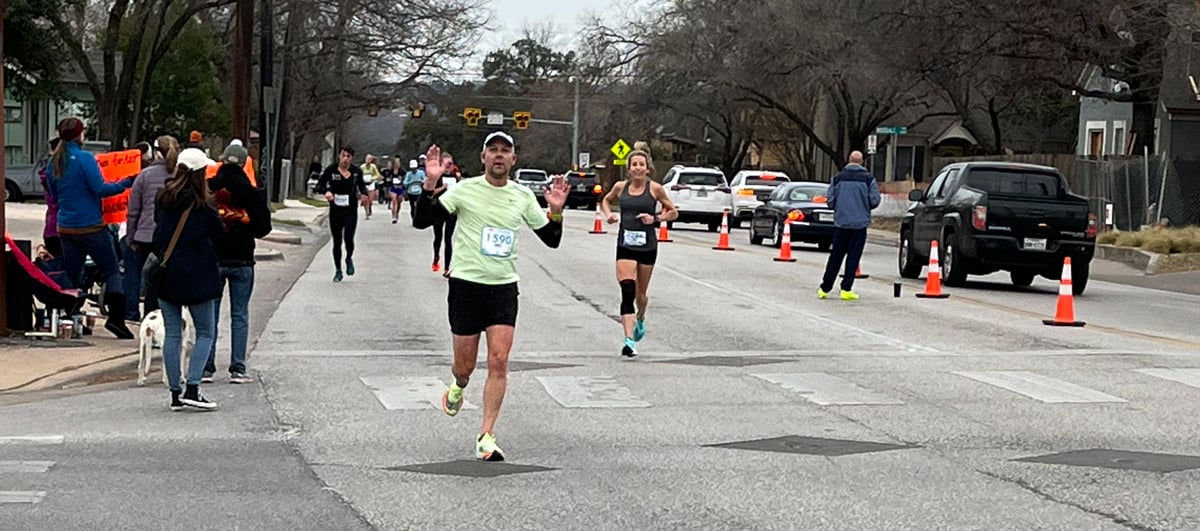 Something was definitely wrong. I was in my early 50s and in the best shape of my life. I’d been training for Chicago for months, aiming to knock a few minutes off my personal best marathon and cross the finish line at around 3 hours and 20 minutes, a time that would qualify me for the Boston Marathon.
As the miles added up and the race grew closer, however, the pain in my hip went from tender to agonizing. No matter how much I stretched, it wouldn’t go away. After visiting the doctor and undergoing some tests, I got the phone call I’d been dreading: I needed to see a surgeon as soon as possible.
My hip was broken. I’d developed a stress fracture from the mechanics of my movement. Worst of all, I would need to stop running to properly heal.
Stop running.
I wasn’t sure what that even meant. I’d been running at least a mile every day for the past three-and-a-half years. I hadn’t missed a single day since early 2020, running at 4:00 a.m. in parking garages, squeezing in a quick jog before I called it a night, or signing off of my laptop during the workweek for my more typical midday runs.
A Pandemic Whim
To understand how fully my life had transformed to accommodate my running, let’s back up to March 2020 when the pandemic was turning the world upside down.
I was living in Raleigh, North Carolina, while my wife was living in San Francisco. With everything that was going on, we weren’t sure when we would see each other again.
We were also running partners. We had a close group of friends on the West Coast and before the pandemic, we tried to run together at least once a week. The stress and uncertainty of that time was heavy on all of us, so to stay connected and think about something else, we started running and checking in on one another.
We’d been cooped up for weeks at one point when I challenged the group.
“Let’s run every day in April,” I said. “Let’s just have some fun with this. We don’t know what we can do. Let’s get outside and enjoy spring and get healthy.”
The rules were simple: each of us had to run at least one mile, every day. Pace didn’t matter. We would check in with each other and keep up the commitment.
Just like that, we all started running. Everybody did it the first day. We all ran for the first week. At the end of April, everybody made it.
At that point, whether we said it out loud or not, we had already left the starting line. We were committed to running by our golden rule: one mile a day, every day.
Nobody wanted to be the first to quit. We worked our way through May, and then the months just started progressing. We had to deal with birthdays and holidays. At that point I’d started traveling again to the West Coast, taking planes that had more flight attendants than passengers. I would sit in O’Hare International Airport, not seeing anyone walk by for two or three minutes at a time. Sometimes it felt apocalyptic, but we kept up the running.
We started getting ambitious. We started thinking that we should run a marathon. One person in the group struggled with weight and another with diabetes. I hadn’t finished a marathon in 25 years. But we all committed to making it happen.
We picked the 2021 California International Marathon as our target race, and we all ran it. Everyone in the group ran their best times ever. We had a great race, a great time, and a great group of friends. It was all thanks to running.
Lunch Break Running
 By this point, I realized my priorities were evolving. For much of my life, up to the start of my run streak, I’d been prioritizing my work schedule above some of the personal things I wanted to do. I was trading time with people or things that were important to me, with the idea that it would boost my career.
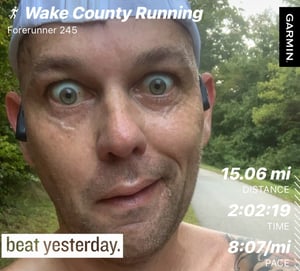
But when I started running and thinking about my run streak, it flipped. I looked at my schedule and picked a time that I would commit to running, every day, to keep my streak alive. I picked noon. At 11:50 am, I was ready to go for a run. I closed my laptop at noon, was out the door, and ran whatever distance I had planned for the day.
By the end of the first year, I was on pace to run around 1,400 miles for the year. Running began fueling my productivity. I was more organized with my work. I wasn’t as stressed. I just felt better. I knew I could solve any problem I wanted while I was out running. During my runs, I would think about my breathing, how my heart was beating, how my feet were hitting the ground, and about how fast I was turning over my steps. It was transcendental.
Work issues, problems, and challenges, they all started to melt away because I was just thinking about a few things. Once I cleared out all the noise in my head, it was easier to break a problem into little pieces and solve each one.
Of course, not everyone kept running at the same pace. Of our group, four kept going for another year, and three of us were still running at least a mile-a-day, every day, by the time I ended up on crutches in 2023.
Relearning to Run
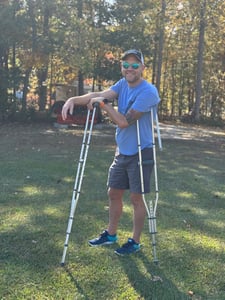 I learned a lot about running during my injury, even when I wasn’t actively in motion. I was off my feet for something like four months as my body healed. My first run, against doctor’s orders, was on New Year’s Day around the park. I paid for it the next day.
Eventually my hip recovered and I could start training again. But I had to start at the beginning; I had to relearn how to run.
Because my injury was the result of a mechanical problem, I had to recalibrate what I’d done literally millions of times up to that point.
Unlearning and relearning is incredibly difficult. I had to think about every step I took. I had to change the way my foot made contact with the ground and guide how that force traveled through my bones and muscles. It was almost like rewiring my instincts.
I’d get on a treadmill, run slowly with my shoes on, take my shoes off, and run even slower. I’d make mental notes, comparing the two running styles. I did that for weeks before I finally felt like I could run outside. It took a year just to get to the point of running three miles without actively focusing on my stride and footfall.
Thankfully, that’s where my professional training kicked in. For years, my running had made me better at my job. Now my professional abilities — developing a plan and knowing how to anticipate obstacles — was guiding my recovery. I was mentally prepared for the training, even if there were activities that I didn’t like. Whether it’s in your work or in your running, developing and sticking to a rhythm is incredibly helpful.
Crossing the Finish Line
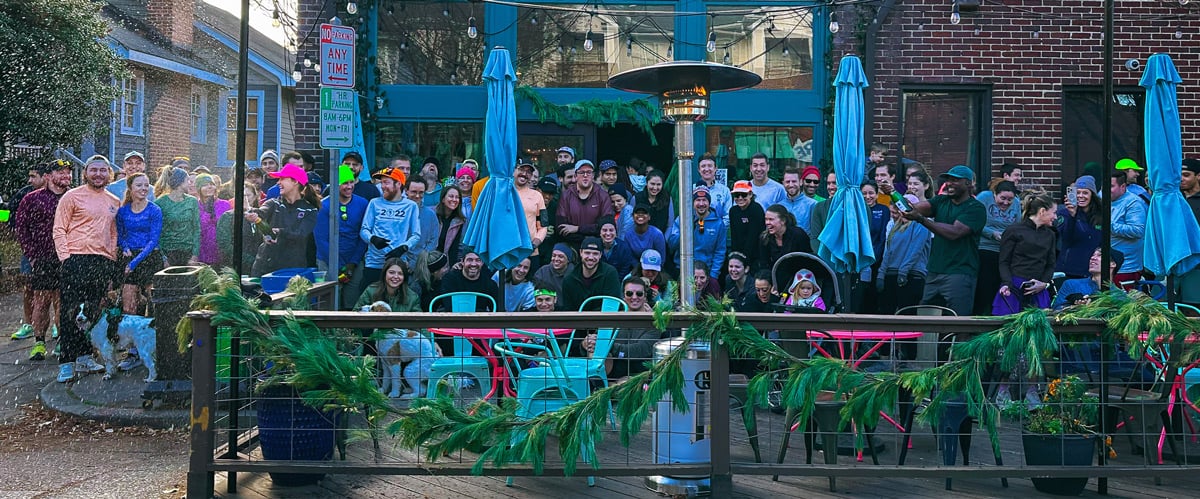 My attitude around training has also changed as I’ve progressed as a runner. Running had long helped me connect with others and foster great friendships, but as my mileage and training plans transformed during my recovery, my ideas about who I ran with changed as well.
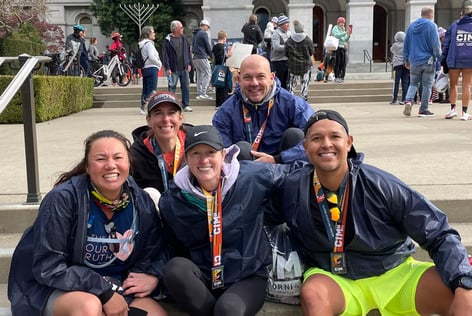
At work conferences or in new cities, I try to meet with friends or set up a group for a run. Our little group of five was a great community during the pandemic; I’ve since built upon that to form an actual formal running group here in Raleigh.
Someday I’d love to put together a standing group on the wealth management conference circuit. Let’s call it “Rusty’s Runners.” Why not? It’d be great to have more people benefitting from a non-work-related outlet for conversations and friendships. Communities are built around helping one another, whether that means answering a question about the latest model of a running shoe or solving an analytics problem.
Once you’ve got that peer group with a shared interest and a shared set of goals, you can start to get somewhere. It's very hard to level up on your own. People do it, but I think it’s a bigger challenge than it seems. Developing relationships, in community, is an opportunity to be even more successful than you could have ever been on your own. Running has helped me keep my stride steady, my mind focused, and, best of all, given me the opportunity to give something back to my community.
TradePMR is a client of Flyer Financial Technologies. No compensation was paid for this article.